 Image 1 of 1
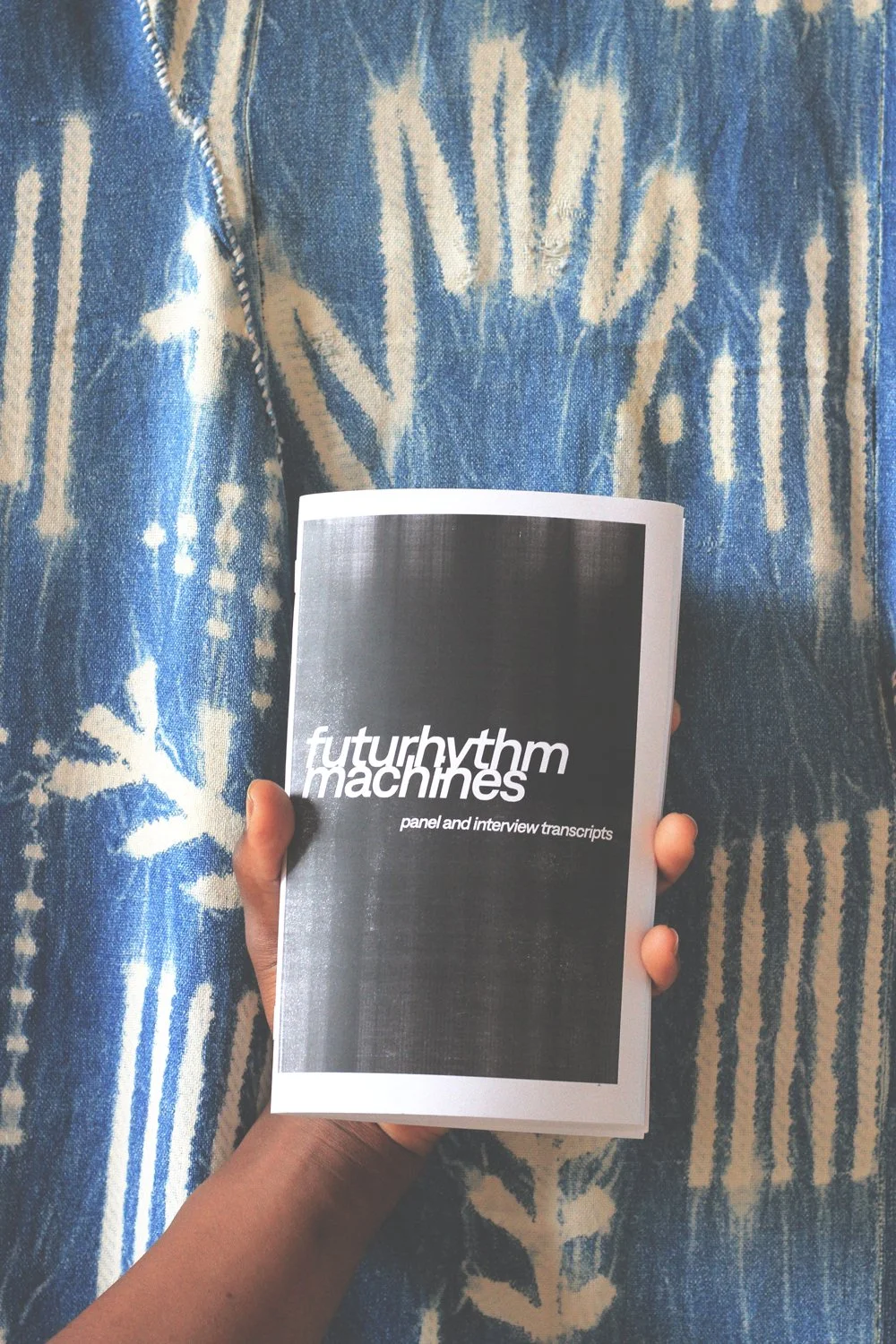
This zine contains transcripts of virtual interviews and a live panel produced as part of the project Futurhythmachines, conceived and produced by the Center for Concrete and Abstract Machines during BADS_lab 2024.
Thanks to drum machines, sound systems, and repurposed warehouses and basements, 1980s Chicago House Music opened up a future that was Black, brown, and queer. DJs invented new ways of keeping and marking time in community. In the years since, computation has made music-making more accessible. What kinds of collectivities are still to come?
Combining complementary modes of thinking, making, and performing, Futurhythmachines: House (FRM:House) was a daylong public event organized during BADS_lab 2024. It featured a DIY synthesizer workshop, a panel discussion, and a DIY synth performance with reception.
FRM:House reflected on social forms, expressive technics, and musical experience through Chicago House Music—discovering therein an art of forming fugitive publics and a science of probing sonic ecologies.
BADS_lab director Muindi Fanuel Muindi (philosopher and poet) moderated a panel with Dr. Thomas DeFrantz (Black social dance historian and technology theorist), DJ Duane Powell (House DJ and music historian), and Meida McNeal (multidisciplinary performance artist and critical ethnographer). They discussed the sonic and social architectures of Chicago House and its surrounds. The panel placed Chicago House within a long lineage of antiphonal experiments in the Black Arts, which have gathered people in movement and in apposition to prevailing paradigms of capture, control, and containment.
In preparation for the event, Muindi also interviewed three critical thinkers about Black Electronic Dance Music in general, and Chicago House specifically: Dhanveer Singh Brar (a researcher focused on histories of Black diasporic culture and politics from the mid-twentieth century onward); Ryan Clarke (tonal geologist and co-curator and organizer of Dweller Festival); R.A. Judy (professor of Critical and Cultural Studies).
Proceeds from this zine directly support the work of BADS_lab.
This zine contains transcripts of virtual interviews and a live panel produced as part of the project Futurhythmachines, conceived and produced by the Center for Concrete and Abstract Machines during BADS_lab 2024.
Thanks to drum machines, sound systems, and repurposed warehouses and basements, 1980s Chicago House Music opened up a future that was Black, brown, and queer. DJs invented new ways of keeping and marking time in community. In the years since, computation has made music-making more accessible. What kinds of collectivities are still to come?
Combining complementary modes of thinking, making, and performing, Futurhythmachines: House (FRM:House) was a daylong public event organized during BADS_lab 2024. It featured a DIY synthesizer workshop, a panel discussion, and a DIY synth performance with reception.
FRM:House reflected on social forms, expressive technics, and musical experience through Chicago House Music—discovering therein an art of forming fugitive publics and a science of probing sonic ecologies.
BADS_lab director Muindi Fanuel Muindi (philosopher and poet) moderated a panel with Dr. Thomas DeFrantz (Black social dance historian and technology theorist), DJ Duane Powell (House DJ and music historian), and Meida McNeal (multidisciplinary performance artist and critical ethnographer). They discussed the sonic and social architectures of Chicago House and its surrounds. The panel placed Chicago House within a long lineage of antiphonal experiments in the Black Arts, which have gathered people in movement and in apposition to prevailing paradigms of capture, control, and containment.
In preparation for the event, Muindi also interviewed three critical thinkers about Black Electronic Dance Music in general, and Chicago House specifically: Dhanveer Singh Brar (a researcher focused on histories of Black diasporic culture and politics from the mid-twentieth century onward); Ryan Clarke (tonal geologist and co-curator and organizer of Dweller Festival); R.A. Judy (professor of Critical and Cultural Studies).
Proceeds from this zine directly support the work of BADS_lab.