 Image 1 of 1
In September 2025, BADS_lab co-produced BLACK: Cite; Sight– Site with Africa Is Everywhere, occupying a unused storefront in São Paulo’s Galeria do Reggae — a neglected hub of African, Afro-Brazilian, and Afro-Caribbean cultural and commercial exchange. Grounded in ubuntu and the concept of “people-as-infrastructure,” we convened fifteen fellows from across the African diaspora to examine how Black communities generate global cultural and economic systems outside rigid institutions. Coinciding with the 36th São Paulo Bienial, the activation functioned as both an exhibition and a participatory laboratory, bringing together visual artists, designers, performers, and cultural practitioners.
BLACK Cite; Sight– Site took as its point of departure an examination of how new African migrants in São Paulo enact practices that extend a long history of Afro-diasporic world-making, revealing African urbanity not as a continental location but as a mobile, relational formation. These practices—spatial improvisation, economic circulation, cultural production, and mutual aid—are often misread as informal or marginal, yet they comprise coherent systems of infrastructure built through the logic of Ubuntu: an ethic and practice of collective inter/intra-dependence. Ubuntu is not an abstract value; it is what Sylvia Wynter might call the hidden ceremony that sustains movement, relation, and survival under coercive power.
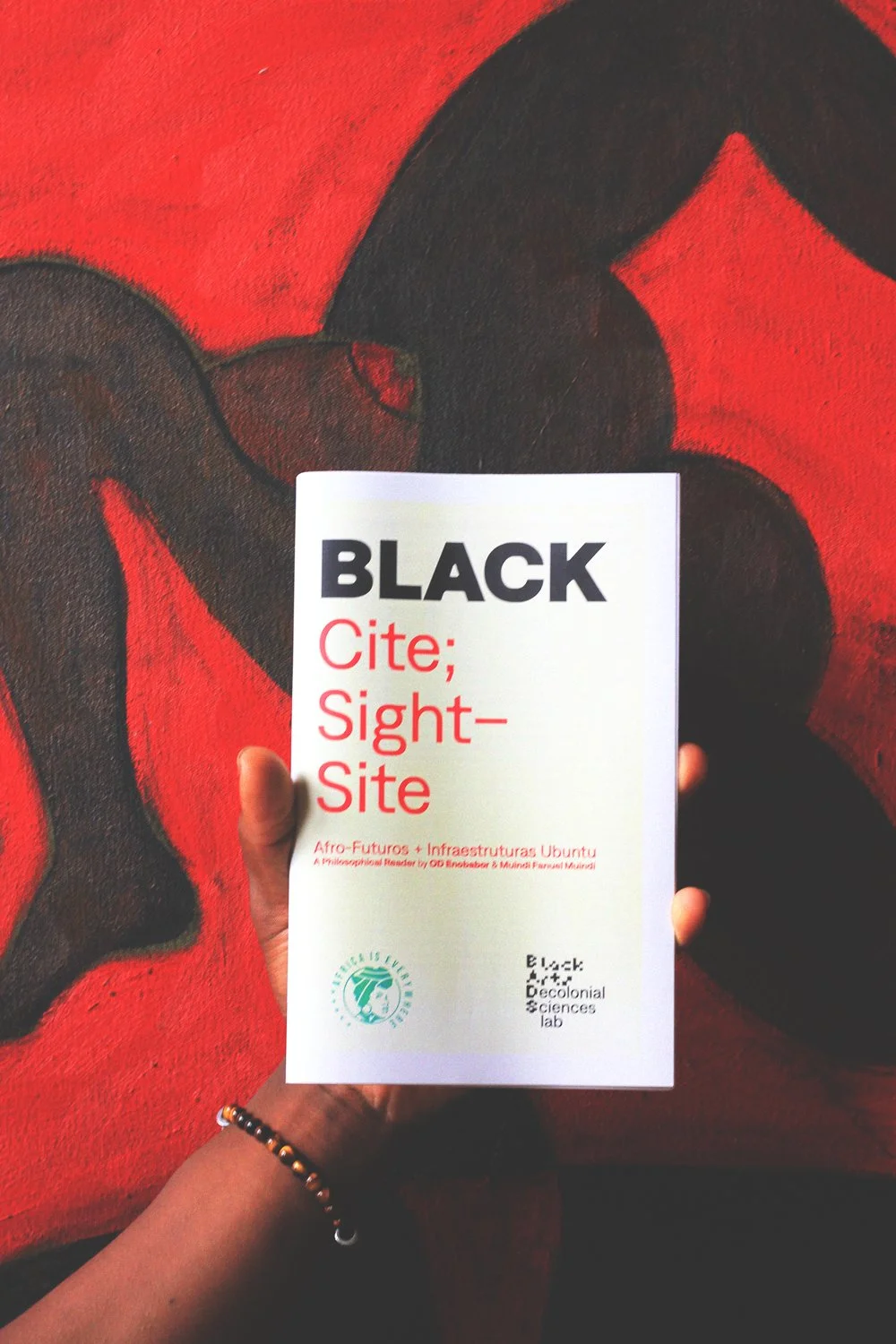
This zine, co-authored by O.D. Enobabor and Muindi Fanuel Muindi, articulates a mosaic of Black critical thought, situated within and transformed by what Stuart Hall describes as the end of “the essential Black subject,” gesturing toward a reconciliation amidst the ruins of a violently constructed “Black Atlantic.” The texts gathered introduce coordinates for understanding that involve: the ability to “cite” our intellectual lineages, to “sight” what has been misrecognized or obscured, and to “site” our claims within lived spatial realities. Together, these practices help us resist the contradictory and relentless pressures of Afro-Modernity—a condition that Muindi Fanuel Muindi defines as a “Diffractive Africa,” where identity, place, and politics are continuously fragmented and redirected. These texts move between concept and action, theory and practice, operationalizing themselves as a platform for ceremonial initiation—a practice we regard as integral to the realization of generative encounters.
In September 2025, BADS_lab co-produced BLACK: Cite; Sight– Site with Africa Is Everywhere, occupying a unused storefront in São Paulo’s Galeria do Reggae — a neglected hub of African, Afro-Brazilian, and Afro-Caribbean cultural and commercial exchange. Grounded in ubuntu and the concept of “people-as-infrastructure,” we convened fifteen fellows from across the African diaspora to examine how Black communities generate global cultural and economic systems outside rigid institutions. Coinciding with the 36th São Paulo Bienial, the activation functioned as both an exhibition and a participatory laboratory, bringing together visual artists, designers, performers, and cultural practitioners.
BLACK Cite; Sight– Site took as its point of departure an examination of how new African migrants in São Paulo enact practices that extend a long history of Afro-diasporic world-making, revealing African urbanity not as a continental location but as a mobile, relational formation. These practices—spatial improvisation, economic circulation, cultural production, and mutual aid—are often misread as informal or marginal, yet they comprise coherent systems of infrastructure built through the logic of Ubuntu: an ethic and practice of collective inter/intra-dependence. Ubuntu is not an abstract value; it is what Sylvia Wynter might call the hidden ceremony that sustains movement, relation, and survival under coercive power.
This zine, co-authored by O.D. Enobabor and Muindi Fanuel Muindi, articulates a mosaic of Black critical thought, situated within and transformed by what Stuart Hall describes as the end of “the essential Black subject,” gesturing toward a reconciliation amidst the ruins of a violently constructed “Black Atlantic.” The texts gathered introduce coordinates for understanding that involve: the ability to “cite” our intellectual lineages, to “sight” what has been misrecognized or obscured, and to “site” our claims within lived spatial realities. Together, these practices help us resist the contradictory and relentless pressures of Afro-Modernity—a condition that Muindi Fanuel Muindi defines as a “Diffractive Africa,” where identity, place, and politics are continuously fragmented and redirected. These texts move between concept and action, theory and practice, operationalizing themselves as a platform for ceremonial initiation—a practice we regard as integral to the realization of generative encounters.